Topic Hub
Apple Silicon for Local AI
Apple Silicon has become the most underrated platform for local AI. Unified memory means a Mac with 64GB or 128GB can load models that won't fit on a single $2,000 NVIDIA GPU — and the M4 Max delivers it silently, at 30–40W, with zero driver setup. The trade-off is raw token throughput: an RTX 4090 is roughly 2–3× faster per token. This hub answers the questions Apple Silicon AI users actually have: which Mac fits which model, how MLX compares to llama.cpp, when an external NVIDIA GPU on a Mac makes sense, and how Mac Studio M4 Max competes with NVIDIA DGX Spark and the RTX 5090 for personal AI supercomputing. Includes our Mac Mini cluster guide for distributed inference of 70B+ MoE models.
Top Picks
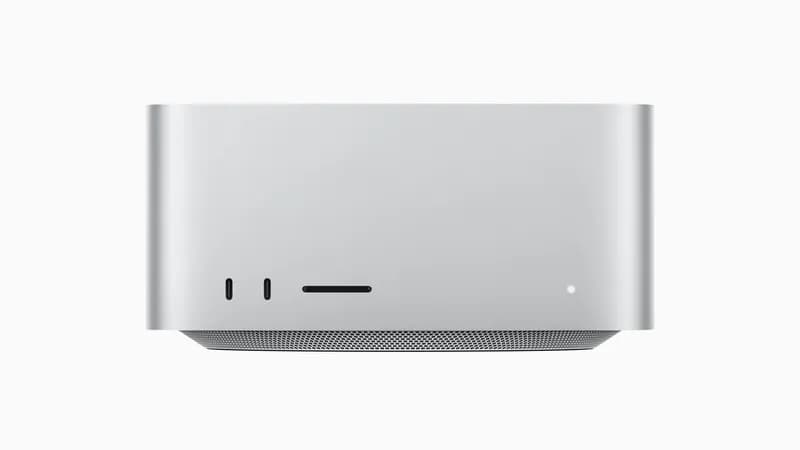
Apple Mac Studio M4 Max
$1,999 – $5,999
- Chip: Apple M4 Max
- CPU Cores: 16-core
- GPU Cores: 40-core
Apple Mac Mini M4 Pro
$1,399 – $1,599
- Chip: Apple M4 Pro
- CPU Cores: 12-core
- GPU Cores: 18-core
Related Articles
Strix Halo vs Mac Studio M4 Max for Local AI: Which Unified-Memory Box in 2026?
The GMKtec EVO-X2 (Ryzen AI Max+ 395 "Strix Halo") and the Mac Studio M4 Max both run big models on shared unified memory with no discrete GPU. We compare 128GB LPDDR5X vs up to 192GB Apple unified memory, the software stacks, price, and who should buy which.
ReadComparisonMLX vs llama.cpp on Apple Silicon: Which Is Faster for Local AI in 2026?
Apple's MLX framework is consistently 30–50% faster than llama.cpp for LLM inference on Apple Silicon — and published academic benchmarks show it sustaining ~230 tokens/sec on optimized 7B models. Here's the head-to-head: when MLX wins, when llama.cpp still wins, and how to set both up on a Mac Mini M4 Pro or Mac Studio M4 Max.
ReadGuideMac Mini Cluster for Local AI 2026 — Run 70B+ Models with EXO and Thunderbolt 5 RDMA
macOS 26.2 added kernel-level RDMA over Thunderbolt 5 and EXO 1.0 shipped day-0 support — turning a stack of M4 Pro Mac Minis into the cheapest practical way to run DeepSeek V3 671B and Llama 4 Maverick at home. Per-tier shopping list, real benchmarks, and a clear decision rule.
ReadGuideHow Much RAM Do You Need for Local AI in 2026? System Memory Guide
32GB is the minimum, 64GB is recommended — but it depends on your models, your workflow, and whether you're on Apple Silicon. The definitive system RAM guide for running AI locally in 2026.
ReadTutorialHow to Use an Nvidia eGPU with Your Mac for Local AI in 2026
Apple just signed Tiny Corp's TinyGPU driver — the first official way to run Nvidia CUDA workloads on Apple Silicon Macs via external GPU. Here's the complete setup guide with GPU picks, enclosure recommendations, benchmarks, and step-by-step instructions for running local LLMs on your Mac + eGPU.
ReadComparisonNVIDIA DGX Spark vs Mac Studio M4 Max: Best AI Desktop for Local Inference in 2026
The DGX Spark ($4,699) brings a petaflop of Grace Blackwell AI compute to your desk. The Mac Studio M4 Max ($3,999 for 128 GB) is the reigning local-AI champion. We benchmark both on real LLM inference, image generation, and total cost of ownership — with a concrete decision matrix for every buyer.
ReadComparisonRTX 5090 vs Mac Studio M4 Max: Which Is Better for Local AI in 2026?
The flagship showdown for local AI in 2026. We compare the RTX 5090 (32 GB GDDR7, CUDA) against the Mac Studio M4 Max (128 GB unified memory, silent) across LLM inference, image generation, software ecosystems, power draw, and total cost of ownership — with workflow-specific verdicts for every buyer.
ReadComparisonMac Mini M4 Pro vs RTX 5060 Ti 16GB for Local AI in 2026: Full Comparison
Mac Mini M4 Pro or RTX 5060 Ti 16GB for local LLM inference? We benchmark both, break down the VRAM trade-offs, and give you a clear decision tree for every use case.
ReadComparisonMac Mini M4 for AI: Is Apple Silicon Worth It in 2026?
A deep look at the Mac Mini M4 and M4 Pro for running local LLMs, AI agents, and inference workloads. Benchmarks, cost analysis, power efficiency, and an honest comparison with NVIDIA GPU rigs.
ReadFrequently Asked Questions
What is the best Mac for running local AI in 2026?
The Mac Studio M4 Max with 128GB unified memory ($3,999–$4,499) is the best Mac for local AI in 2026 — it's the only sub-$5,000 desktop that can run 70B-parameter models unquantized, and it competes directly with the NVIDIA DGX Spark ($4,699) on memory capacity. For users on a tighter budget, the Mac Mini M4 Pro with 24GB unified memory ($1,399) handles 8B–22B models at 20–30 tok/s and is the best silent always-on inference machine under $1,500.
Can a Mac run 70B-parameter language models locally?
Yes. A Mac Studio M4 Max with 128GB unified memory runs 70B models like Llama 3.1 70B and Qwen 3 72B at Q4–Q8 quantization, and a Mac Mini M4 Pro with 64GB runs 70B at Q3 quantization. For larger MoE models like DeepSeek V3 671B or Llama 4 Maverick, an 8× Mac Mini M4 Pro cluster running EXO 1.0 over Thunderbolt 5 RDMA serves DeepSeek V3 at 5.37 tokens per second per published EXO Labs benchmarks — currently the cheapest practical way to run a 671B-parameter model at home.
Is Apple Silicon faster than an NVIDIA GPU for AI?
No — for raw tokens-per-second on models that fit in VRAM, NVIDIA wins. An RTX 4090 or RTX 5090 delivers roughly 2–3× the tokens-per-second of a Mac Studio M4 Max on models under 32GB. Apple Silicon's advantage is unified memory: a 128GB Mac Studio can load models that won't fit on any single $2,000 NVIDIA consumer GPU, and it does so silently at 30–120W vs 350–725W for a comparable NVIDIA build. Choose Apple Silicon for big-model fit, silence, and power efficiency; choose NVIDIA for raw throughput, CUDA-only tools, training, and image/video generation.